Case study 04 · Python · Automation · Bot
InstaBot
A multi-account dashboard to collect, filter and contact Instagram profiles, with real-time monitoring.
- Role
- End-to-end design and development: engine, interface and diagnostic tools
- Category
- Python · Automation · Bot
- Stack
- Python · Flask · Socket.IO
- Quality
- 58 tests
01 — Context
For professionals managing several Instagram accounts, InstaBot brings profile collection and interaction automation together in a web dashboard.
02 — Problem
Building profile lists, switching between accounts and avoiding contacting the same people twice: hours of manual work.
03 — Solution
Users prepare their accounts, import a list or start a collection from accounts and posts. They configure selection criteria, message templates and pacing. The engine spreads profiles across active accounts and picks the action based on available content; jobs run in the background with live monitoring.
04 — Features
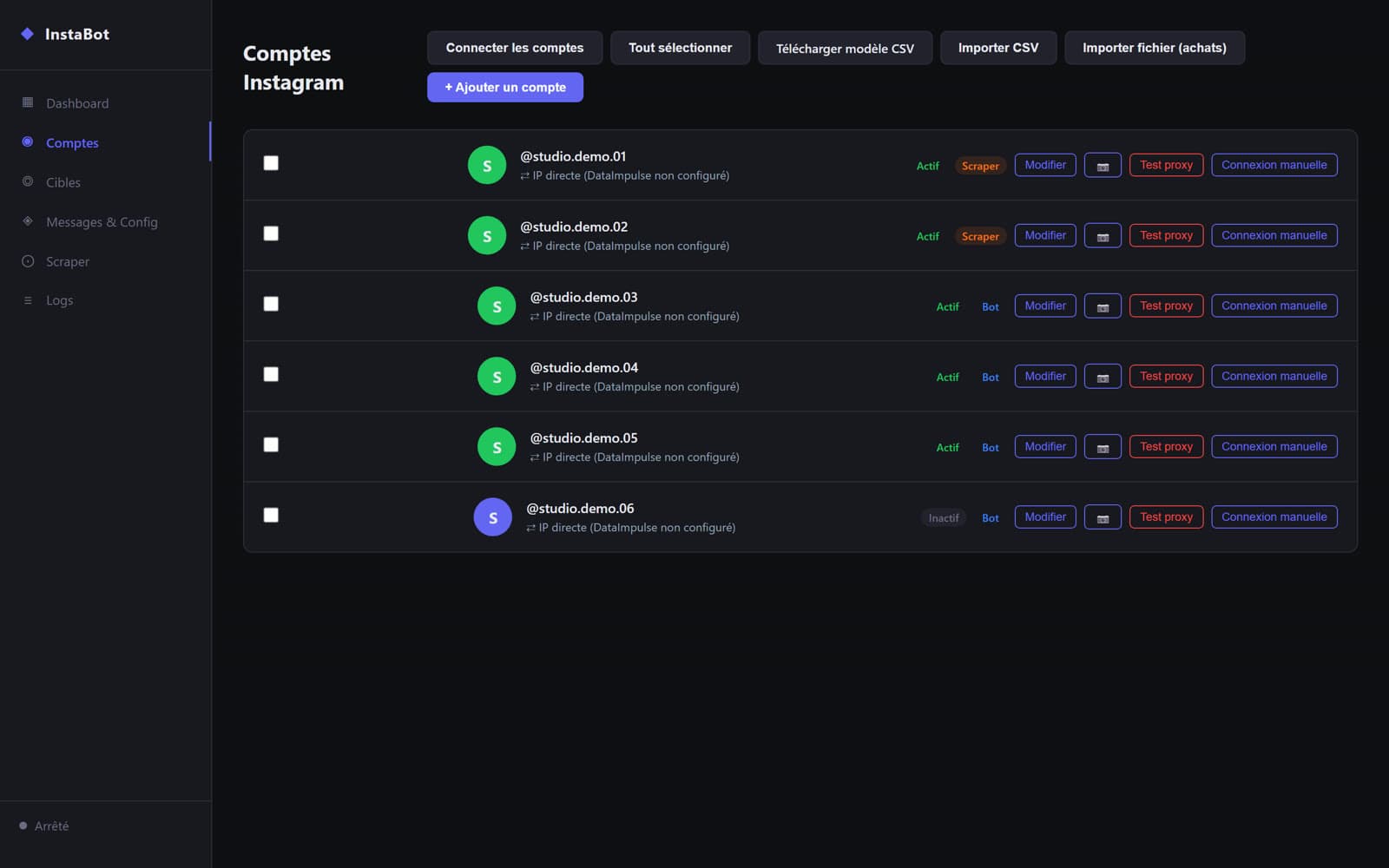
Centralised accounts
Add, import, duplicate detection and per-account roles.
Audience collection
Followers, followings and post interactions, relayed across accounts.
Filtering
Public account, photo, bio, story and follower thresholds.
Interactions
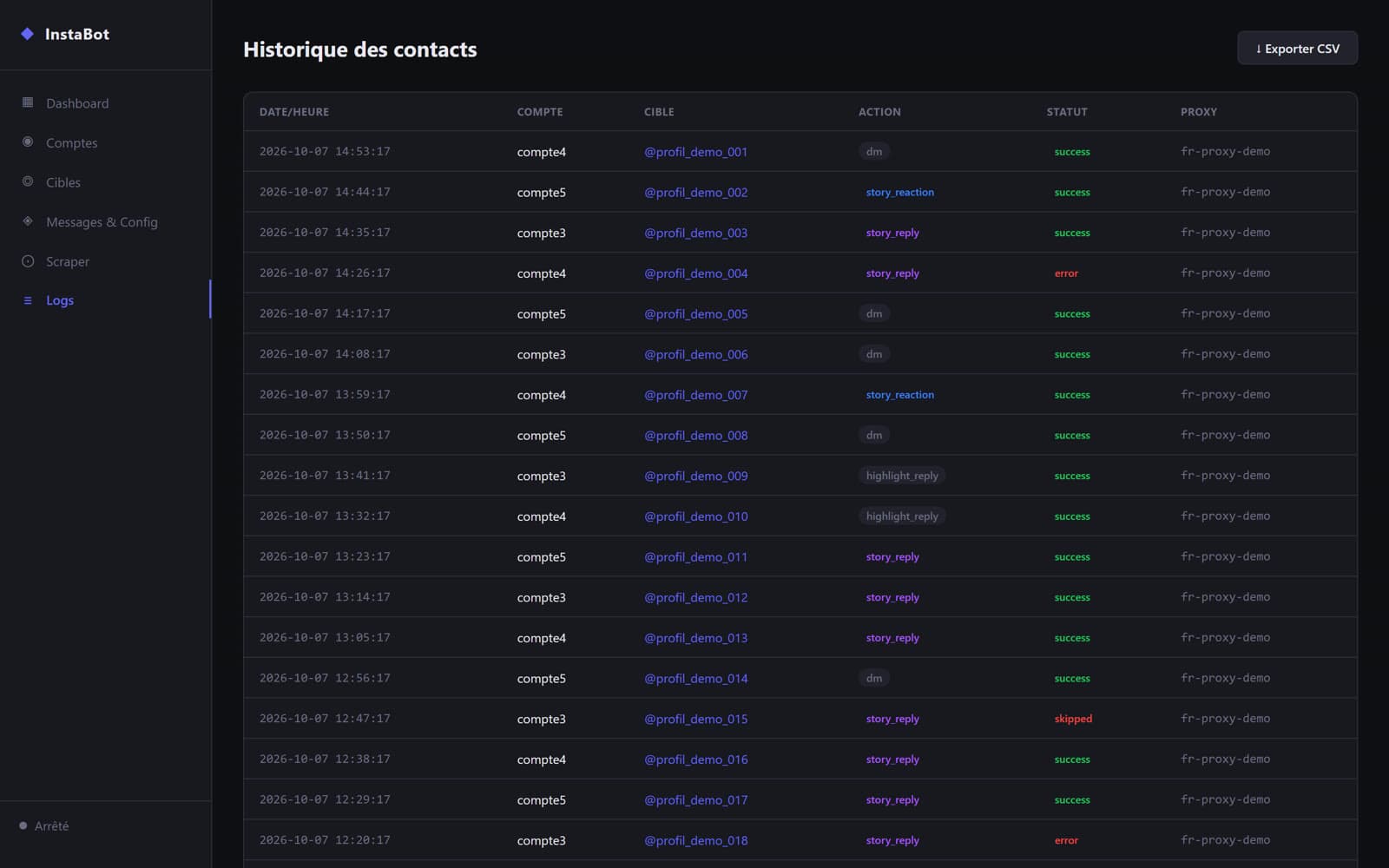
Story replies, highlight replies and direct messages.
Pacing and re-contact
Delays, sleep windows, per-account caps and re-contact delays.
Supervision
Start, stop, live logs and exportable history.
05 — Screenshots
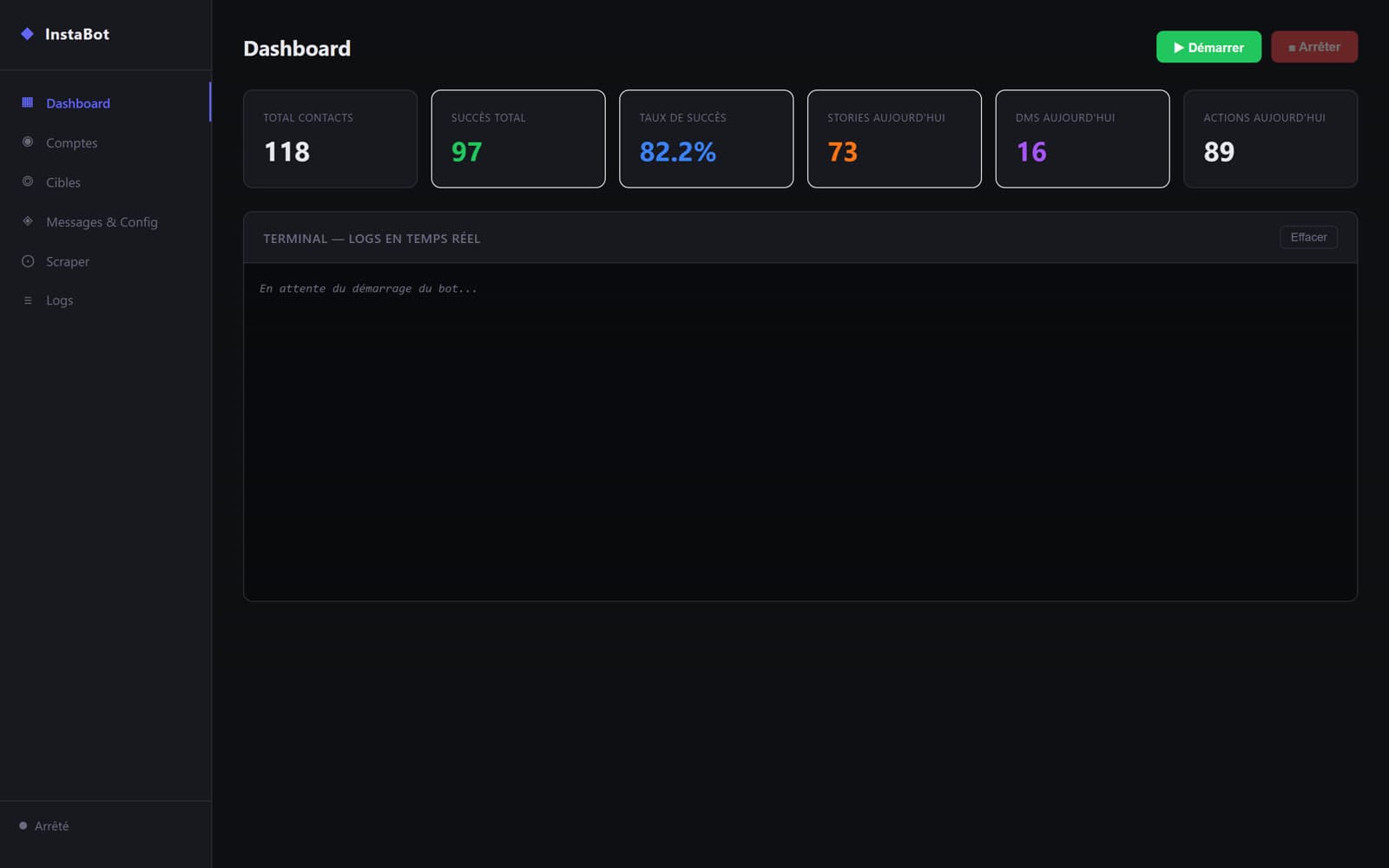
Dashboard with contact statistics 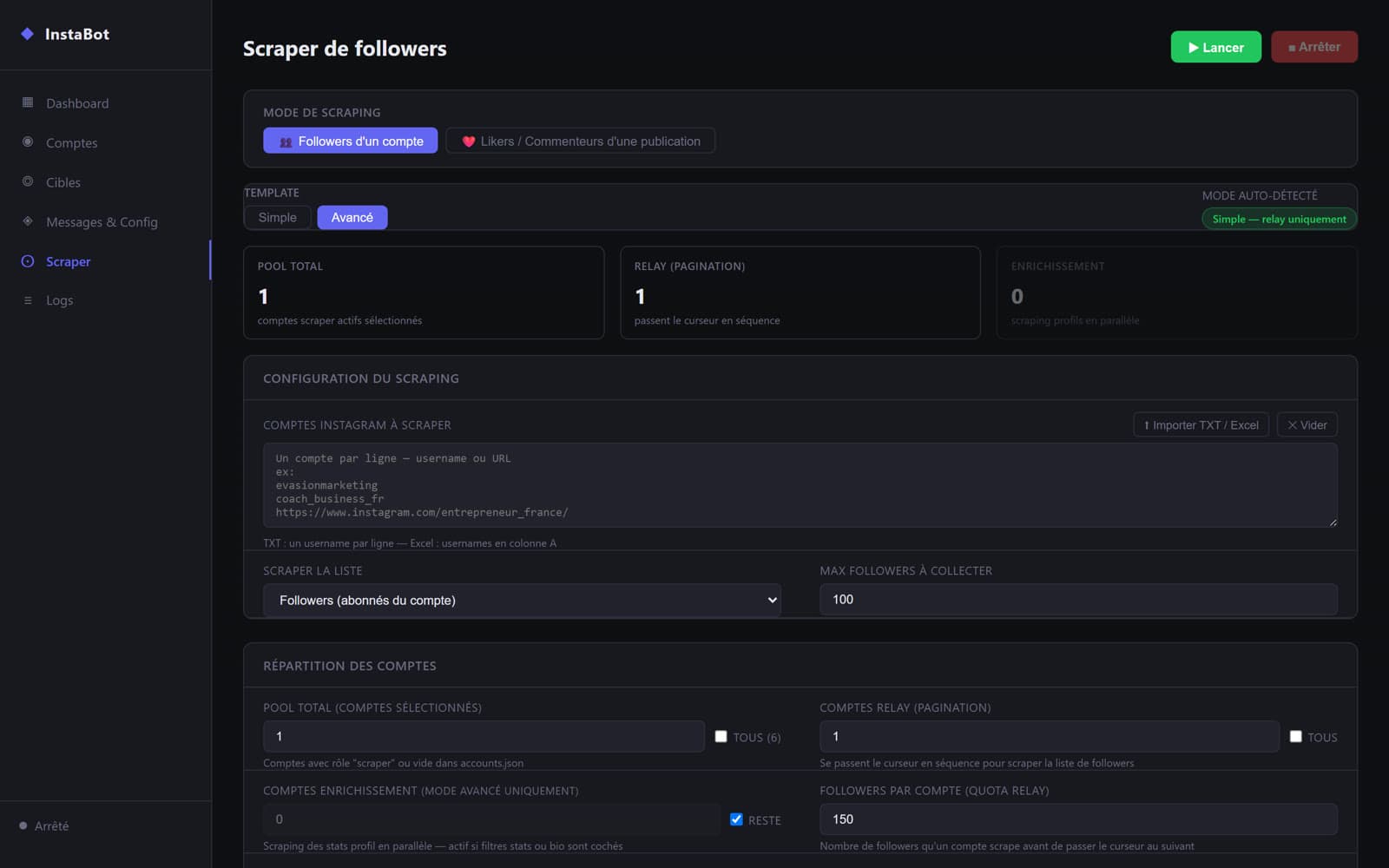
Follower scraper configuration
06 — Architecture
- Web interfaceJinja2 · JavaScript
- Flaskpages · API · auth
- Orchestrationthreads · asyncio
- Playwright servicescollection · interactions
- SQLite · Socket.IOhistory · real time
Flask receives commands and starts jobs in threads that each run their own async loop.
Collection links a producer and consumers through a queue: profiles are enriched as they arrive, without waiting for the full list.
07 — Technical challenges
Challenge
Collect and enrich at the same time.
Solution
A producer / consumer pipeline fed by an asyncio queue.
Challenge
Handle several login states.
Solution
Persistent browser profiles, state detection, TOTP and reconnection.
Challenge
Avoid contacting people too often.
Solution
SQLite history per account and profile, with individual and global delays.
Challenge
Cope with an external interface that changes.
Solution
Externalised selectors with fallbacks, error states and progressive back-off.
08 — My contribution
- Modular architecture and automation scenarios
- Flask backend and management interfaces
- Collectors, filters and asynchronous processing
- SQLite persistence and CSV log
- Browser sessions, two-factor authentication and proxies
- Tests, diagnostic tools and documentation
09 — Stack
- Backend
- Python, Flask, Flask-SocketIO, Eventlet
- Automation
- Playwright, Firefox, asyncio, multiprocessing
- Storage
- SQLite (WAL), CSV, JSON
- Interface
- Jinja2, HTML, CSS, JavaScript, Socket.IO
- Quality
- pytest, outils de diagnostic Playwright
10 — Results
58
passing unit tests
4
interaction types: story reply or reaction, highlight reply, direct message